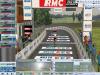
While the Vuelta is starting in Benidorm, the Vattenfall Cyclassics is raced in the North of Germany, with the finish in Hamburg. Last year, we missed the win here with Theo Bos finishing in 2nd behind Tom Boonen.
The Route
219 kilometres with start and finish in Hamburg. Most difficult obstacle is the Waseberg, 700 metres at an average gradient of 11%.
Quickly in the race, the BOTD is formed. 7 riders, Briggs (Sky), Bandiera (OPQ), Paterski (Liq), Haddou (Eur), Romero (Caja Rural), Gruzdev (Ast) and Mori (Lam) create a maximum margin of 8'30.
60km to go
With 60km to go, when the margin to the BOTD is less than 4 minutes, 2 very dangerous riders attack out of the peloton. Fabian Cancellara and Geraint Thomas try to bridge the gap to the peloton.
40km to go
Even before we start to chase Cancellara and Thomas, the domestiques of Astana and Radio Shack have taken over control of the peloton. We really don't know what we see, because it has become very rare that we don't have to do the chase. And with 40km to go, the adventure of Cancellara and Thomas is over. Still 2'20 behind the BOTD.
25km to go
Astana is leading the peloton in the final ascend of the steep Waseberg. Marcel Kittel has made sure to be climbing among the first riders, so he doesn't get behind when the peloton splits into more groups.
19km to go
With 19km to go Greg Van Avermaet attacks out of the peloton, getting countered by Sky's Ben Swift. This is the signal for us to increase the pace.
10km to go
Van Avermaet and Swift bridge the gap to the BOTD, but thanks to our hard chasing work, they all get caught with 10km to go. The Astana-boys have disappeared, as their pace was too high for their sprinter Andrea Guardini, who got dropped!
7km to go
We know that there'll be attacks in the final 10km. And Radio Shacks Bobbie Traksel is the first to do so. The Dutch rider gets countered by Alessandro Ballan, Sebastian Langeveld, Greg Van Avermaet and Sylvain Chavanel. For a moment, we believe that we are racing a cobbled race here.
3km to go
With Sylvain Chavanel and Sebastian Langeveld doing one final desperate attempt, Thomas Dekker keeps the pace of the peloton that high, that they can't create a gap. Final lead out man Coen Vermeltfoort is behind him, with Marcel Kittel in his wheel.
1500m to go
Only 24 riders are able to stay in the first group, and with the other sprinters being without their train our can't find Kittels wheel, the situation looks great for us. Especially with Jerome Baugnies (Vacansoleil) as the only one that can keep the wheel of the German champion.
700m to go
Marcel Kittel has been launched perfectly and is cruising towards the win in Hamburg. Baugnies is in the race for the 2nd place, while Tom Boonen has found a gap and tries 1 desperate attempt to win the race as last year.
Finish
But what a domination this is by Marcel Kittel, taking his 10th win of the season, and the 4th in August! Jérome Baugnies surprises with the 2nd place, Boonen takes the 3rd and even our final lead out man Coen Vermeltfoort finishes before the other sprinters in 4th.
Results
1
Marcel Kittel
Petronas - Monster Energy
5h15'41
2
Jérôme Baugnies
Vacansoleil - DCM Pro Cycling Team
s.t.
3
Tom Boonen
Katusha Team
s.t.
4
Coen Vermeltfoort
Petronas - Monster Energy
s.t.
5
Bobbie Traksel
Radio Shack - Nissan
s.t.
6
Francisco José Ventoso
Euskaltel - Euskadi
s.t.
7
Giovanni Visconti
Katusha Team
s.t.
8
Tyler Farrar
Garmin - Barracuda
s.t.
9
Jakob Fuglsang
Radio Shack - Nissan
s.t.
10
Enrico Gasparotto
Katusha Team
s.t.
The Winner
Word from the DS
We know that he field in the Vattenfall Cyclassics was very weak (when you're wondering were all the fast sprinters are, just wait for the Vuelta preview ), but still the race has to be done. The team did a great job, with Marcel Kittel finishing it off perfectly!
It's already time for the final Grand Tour of 2014, the Vuelta ciclista a España. 21 days in the heat, riding Spains steepest climbs. Roberto Heras is the record winner with 4 wins. Last year, Vincenzo Nibali took his 2nd GC-win, after being way too strong for Igor Antón and Andy Schleck.
The Route
3330 kilometres, divided in 1 TTT, 1 ITT (total of 58 TT-kilometres), 5 flat stages, 8 hilly stages, 6 mountain stages and 7 hill/mountain top finishes.
Stage 1-3
The 69th edition of the Vuelta starts in the region Valencia. The first stage is a 16km TTT in the streets of Benidorm, located at the Costa Blanca. The Vuelta-circus stays near the costal line, with the finish in Orihuela in stage 2. The next day, the peloton leaves Valencia and enters the region of Murcia, to finish in Totana. The 3rd category climb Alto de la Santa with the summit 12km before the finish, may disrupt the sprint trains.
Stage 4-6
Already in stage 4 await the mountains. 2 climbs of over 200 metres altitude, first the Sierra de Filabres and the finish at Sierra Nevada at an altitude of 2126 metres, will cause a shift in the GC. We stay in Andalucía for the 5th stage, a undulating route with the finish at a very steep wall in Valdepeñas de Jaén. Stage 6 finishes in the hottest city of Europe Córdoba, for months the temperature is above 35 degrees Celsius. The Alto de San Jerónimo will probably prevent a mass sprint to happen.
Stage 7-9
Finally a flat stage! Stage 7 enters the region of Castilla - La Mancha and finishes in Talavera de la Reina. Another mass sprint? Stage 8 is very difficult again, as it finishes in the historical town of San Lorenzo de El Escorial, known for it's Escorial, where 26 Spanish kings are buried. The next day awaits another mountain top finish. The route is pretty easy, untill the final ascend to La Covatilla (19.9km at 5.8%).
Stage 10-12
We travel from the region Madrid to Castilla y León for the only ITT in this Vuelta: 42 kilometres with start and finish in Salamanca. After the first rest day awaits the 3rd mountain top finish, the Estación de Montaña Manzaneda (22km at 6.4%). The GC-contenders can rest the next day with another stage in Galicia, but this one is flat and finishes in Pontevedra.
Stage 13-15
Back into Castilia y León for another difficult stage. But with 2 mountain stages to come, this one can be for a breakaway. And when the riders enter Asturias, they know that trouble awaits them. Stage 14 features 2 horrible climbs in the final 40 kilometres: first the Puerto de San Lorenzo (10,6km at 8.2%) and finally the Lagos de Somiedo (20km at 5.5%). In stage 15 awaits La Gamonal, the Alto de El Angliru. This probably most difficult climb in Europe is 12.5km long and has an average gradient of 10.1%. The steepest part, the Cueñas les Cabres, has a gradient of 23.5%!
Stage 16-18
A fully deserved flat stage in stage 16, with the finish in Haro. If sprintes have survived the mountains, they can sprint for the win here. The last mountain top finish, thus probably the last chance for the GC-contenders to improve their position, is the Peña Cabarga. 6 kilometres at 9.4% average, with a maximum gradient of 18% in the last part of the climb. Stage 18 is hilly, so the GC-contenders should be cautious not to loose time here in Noja.
Stage 19-21
2 stages in Basque country means 2 hilly stages. The first of the 2 finishes in Bilbao and features 2 ascends of the Alto El Vivero in the final 50km. The penultimate stage of this Vuelta finishes in Vitoria-Gasteiz. But as the last summit is is located 46 kilometres before the finish in the capitol of Basque country, no time gaps are expected. The Vuelta ends in Madrid, after a short (96km) and flat stage.
Ian Butler wrote:
Well, it's the Vuelta, lots of uphill finishes. Curious to see the startlist!
Well, that'll be posted tuesday or probably wednesday. So be patient!
Spoiler
GC: Weak field, with COntador and Gesink as the 2 favourites, and further riders as Wiggins, Cobo, De Gendt, Taaramäe.
Sprinters: Except Kittel, Farrar and Guardini, all are present, so besides Sagan it is Cavendish, Greipel, Boasson Hagen, Rojas, Bos, Feillu, Gavazzi, Keukeleire, Goss and Haussler. Not bad?!











 Jérôme Baugnies
 Francisco José Ventoso
 Giovanni Visconti
 Tyler Farrar
 Jakob Fuglsang